





What Is The Ram Truck Towing Capacity?
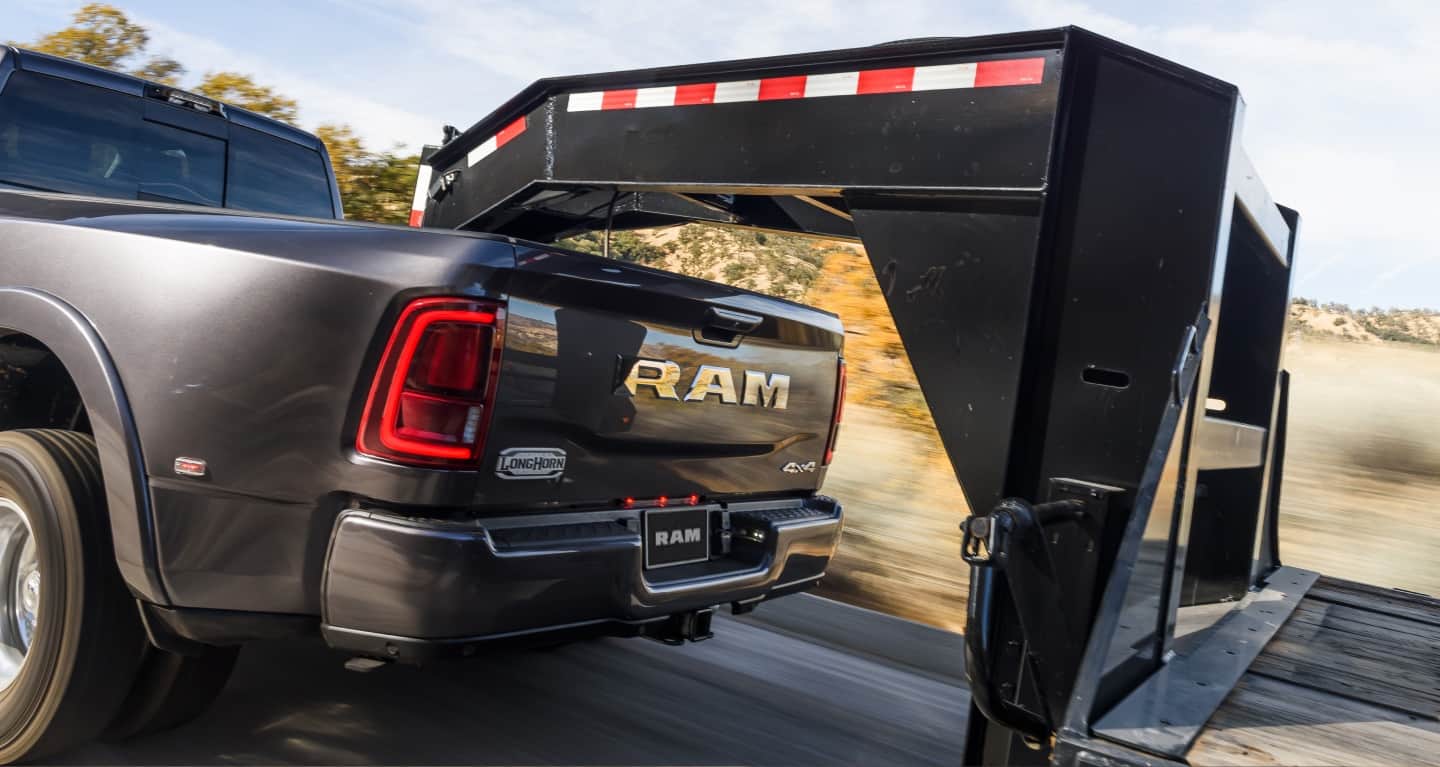
Photo Source/Copyright: Ram
There’s no single number here. Ram truck towing capacity moves with the model, engine, cab, bed, and axle ratio you end up walking out with. The lineup splits into three trucks that were never built to do the same job.
How Much Can a Ram Truck Actually Pull?
The numbers below are ceilings. Options and configuration only drag them down from there, so read them as a high-water mark instead of a promise about whatever truck happens to be parked out front.
- Ram 1500: up to 11,610 pounds when properly equipped
- Ram 2500: up to 20,000 pounds with the High-Output Cummins Turbo Diesel
- Ram 3500: up to 36,610 pounds with the High-Output Cummins and dual rear wheels
Half-Ton Numbers in the 1500
Half-ton Ram truck towing capacity splits into four tiers, and the pecking order catches people off guard. The 3.0-liter Hurricane I-6 in standard output tops the range at 11,610 pounds. The 5.7-liter HEMI V-8 trails it by less than three hundred, at 11,320. Then the high-output Hurricane, the 540-horsepower one, drops all the way down to 10,000.
That last one trips up shoppers constantly. It’s by design, because the high-output tune chases acceleration and passing power, and neither of those has much to do with the sustained heat and gearing a heavy trailer demands.
The 3.6-liter Pentastar V-6 with eTorque anchors the bottom at 8,130 pounds. Payload across the 1500 range peaks around 2,360. Every figure on that list assumes the right cab, bed, and axle ratio sitting underneath it, too.
Where Heavy Duty Takes Over
The 2500 and 3500 aren’t scaled-up 1500s. Different frame, different suspension, different driveline, which is why they carry a whole different hitch class. Torque runs the show up here. Horsepower gets you up the on-ramp. Torque is what holds you at highway speed halfway up an incline with twenty thousand pounds hanging off the back.
In the 2500, the 6.4-liter HEMI V-8 pulls up to 17,740 pounds. Step up to the High-Output 6.7-liter Cummins Turbo Diesel, and you gain better than two thousand more, landing on an even 20,000. The 3500 stretches the gap even wider. Its gas V-8 handles 18,150 pounds. The High-Output Cummins, with 430 horsepower and 1,075 pound-feet of torque, roughly doubles the gas number once dual rear wheels come into it.
| Model | Maximum Towing | Best Suited For |
|---|---|---|
| Ram 1500 | 11,610 lb | Boats, campers, utility and car trailers |
| Ram 2500 | 20,000 lb | Equipment trailers, livestock, large fifth-wheel loads |
| Ram 3500 | 36,610 lb | Gooseneck, commercial flatbed, full-size RV |
All figures when properly equipped. Trailer weight and payload draw from the same total.
What Actually Sets Your Number
Here’s the part the capacity charts bury. Passengers, fuel, gear, and hitch hardware all draw from the same allowance, and Ram truck towing capacity is whatever remains. Two identical trucks on the same lot can post different real-world numbers the moment you load them up. A handful of things strongly influence towing figures:
- Engine: the largest single factor in any rating
- Axle ratio: a numerically higher ratio raises the ceiling
- Cab and bed: lighter configurations rate higher than heavier ones
- Tow equipment: hitch class, brake controller, and package content set the legal limit
Matching the Truck to the Trailer
Rough guide: boats, travel trailers, and car haulers sit comfortably in half-ton territory. Equipment trailers, livestock, and fifth-wheel loads belong with heavy-duty vehicles. The overlap in the middle is where most of the second-guessing happens.
Past roughly 5,000 pounds, a weight-distributing hitch stops being optional. Past 20,000 on the 2500 or 23,000 on the 3500, you’re into gooseneck or fifth-wheel territory. Before you sign anything, go weigh what you actually tow. Then come schedule a test drive and run two or three setups back-to-back, because a loaded 3500 needs to be felt personally at merge speed.
Frequently Asked Questions
Q: How much weight can a Ram 1500 tow?
A: Up to 11,610 pounds with the standard-output Hurricane I-6, provided the cab, bed, axle ratio, and tow equipment all line up. The other three engines in the 1500 range come in under that.
Q: How many tons can a Ram truck pull?
A: The 3500 tops the lineup at 36,610 pounds (roughly eighteen tons) with the High-Output Cummins Turbo Diesel and dual rear wheels. You need a gooseneck or fifth-wheel hitch to actually get there.
Q: Does engine choice change the rating?
A: It does, and not always in the direction you’d guess. Ram truck towing capacity can fall as horsepower climbs, which is exactly what the 1500’s high-output Hurricane does. Sprinting and grinding ask different things of an engine. Pick the trailer first, then the truck, then the trim.
More From University Dodge Ram
Quick Dodge Challenger Lug Pattern Wheel Guide
Photo Source/Copyright: Stellantis What gives the modern Dodge Challenger its rock-solid wheel fitment? The Dodge Challenger lug pattern is 5×115 millimeters (mm) (5 x 4.53 inches) on the current-generation muscle car. The first number counts the wheel studs, and the second is the diameter of the circle they sit on. Earlier generations used…
How Does The HEMI eTorque Engine Work?
Photo Source/Copyright: Stellantis Have you ever wondered how Ram gets extra muscle out of its classic V-8 without sacrificing its legendary rumble? HEMI eTorque is Ram’s 5.7-liter HEMI V-8 paired with a 48-volt mild-hybrid system. In place of the engine-mounted alternator, a belt-driven motor generator unit supplies up to 130 pound-feet of supplemental torque…
Why Dodge Muscle Cars Control The Road
What allows Dodge muscle cars to maintain their dominant stance on American roadways? Dodge has built its reputation on high-performance muscle cars, with iconic models like the Charger and Challenger leading the brand’s modern performance lineup. Known for powerful engine options, aggressive styling, and track-inspired capabilities, Dodge muscle cars continue to appeal to drivers seeking…